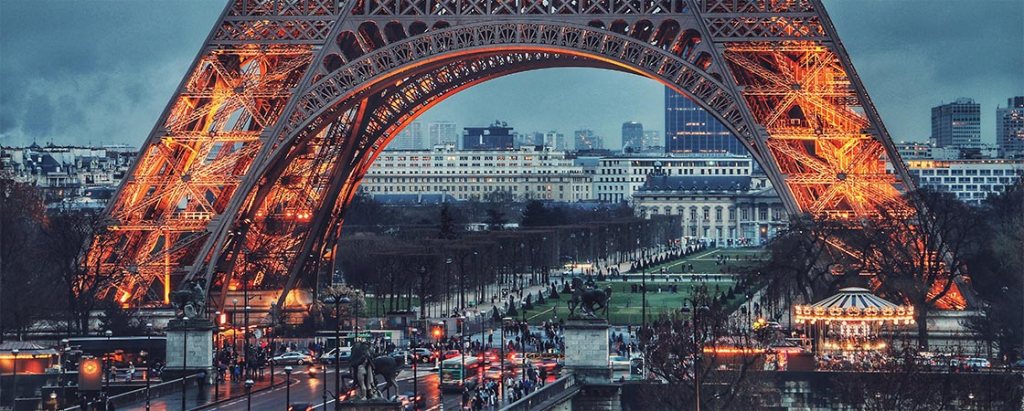
Tourism

Tourists from around the world make the Louvre the most-visited art museum in the world.
Greater Paris, comprising Paris and its three surrounding departments, received 23.6 million visitors in 2017, measured by hotel arrivals. These included 12 million foreign visitors and 11.5 million French visitors. Of foreign visitors, the greatest number came from the United States (2 million), Great Britain (1.1 million), Germany (802.6 thousand) and China (774.4 thousand).[199]
In 2016, measured by the MasterCard Global Cities Destination Index, Paris was the third-busiest airline destination in the world, with 18.03 million visitors, behind Bangkok (21.47 million) and London (19.88 million).[200] According to the Paris Convention and Visitors Bureau, 393,008 workers in Greater Paris, or 12.4% of the total workforce, are engaged in tourism-related sectors such as hotels, catering, transport, and leisure.[201]
Monuments and attractions
Main articles: Landmarks in Paris, Historical quarters of Paris, and List of tourist attractions in Paris
See also: List of most visited museums

The city’s top tourist attraction was the Notre Dame Cathedral, which welcomed an estimated 12,000,000 visitors in 2017. Second was the Basilique du Sacré-Cœur on Montmartre, with an estimated 11 million visitors. This was followed by the Louvre Museum (8.02 million visitors); the Eiffel Tower (6.2 million); Centre Pompidou (3.3 million visitors); Musée d’Orsay (3.2 million); The City of Science and Industry (2.4 million visitors); The Chapel of Our Lady of the Miraculous Medal (2 million visitors); The Museum of Natural History (1.7 million visitors); and the Arc de Triomphe (1.3 million visitors).[202]
| UNESCO World Heritage Site | |
| Criteria | Cultural: i, ii, iv |
| Reference | 600 |
| Inscription | 1991 (15th Session) |
| Area | 365 ha |
The centre of Paris contains the most visited monuments in the city, including the Notre Dame Cathedral and the Louvre as well as the Sainte-Chapelle; Les Invalides, where the tomb of Napoleon is located, and the Eiffel Tower are located on the Left Bank south-west of the centre. The Panthéon and the Catacombs of Paris are also located on the Left Bank of the Seine. The banks of the Seine from the Pont de Sully to the Pont d’Iéna have been listed as a UNESCO World Heritage Site since 1991.[203]

The Axe historique, pictured here from Concorde to Grande Arche of La Défense

Other landmarks are laid out east to west along the historical axis of Paris, which runs from the Louvre through the Tuileries Garden, the Luxor Column in the Place de la Concorde, and the Arc de Triomphe, to the Grande Arche of La Défense.
Several other much-visited landmarks are located in the suburbs of the city; the Basilica of St Denis, in Seine-Saint-Denis, is the birthplace of the Gothic style of architecture and the royal necropolis of French kings and queens.[204] The Paris region hosts three other UNESCO Heritage sites: the Palace of Versailles in the west,[205] the Palace of Fontainebleau in the south,[206] and the medieval fairs site of Provins in the east.[207] In the Paris region, Disneyland Paris, in Marne-la-Vallée, 32 kilometres (20 miles) east of the centre of Paris, received 9.66 million visitors in 2017.[208]
Hotels
In 2017 Greater Paris had 2,020 hotels, including 85 five-star hotels, with a total of 119,000 rooms.[209] Paris has long been famous for its grand hotels. The Hotel Meurice, opened for British travellers in 1817, was one of the first luxury hotels in Paris.[210] The arrival of the railways and the Paris Exposition of 1855 brought the first flood of tourists and the first modern grand hotels; the Hôtel du Louvre (now an antiques marketplace) in 1855; the Grand Hotel (now the InterContinental Paris Le Grand Hotel) in 1862; and the Hôtel Continental in 1878. The Hôtel Ritz on Place Vendôme opened in 1898, followed by the Hôtel Crillon in an 18th-century building on the Place de la Concorde in 1909; the Hotel Bristol on the Rue du Faubourg Saint-Honoré in 1925; and the Hotel George V in 1928.[211]
In addition to hotels, in 2017 Greater Paris had 84,000 homes registered with Airbnb, which received 2.3 million visitors.[209] Under French law, renters of these units must pay the Paris tourism tax. The company paid the city government 7.3 million Euros in 2016.[212]
Culture
Painting and sculpture
Main article: Art in Paris

Pierre Mignard, Self-portrait, between 1670 and 1690, oil on canvas, 235 cm × 188 cm (93 in × 74 in), Louvre
For centuries, Paris has attracted artists from around the world, who arrive in the city to educate themselves and to seek inspiration from its vast pool of artistic resources and galleries. As a result, Paris has acquired a reputation as the “City of Art”.[213] Italian artists were a profound influence on the development of art in Paris in the 16th and 17th centuries, particularly in sculpture and reliefs. Painting and sculpture became the pride of the French monarchy and the French royal family commissioned many Parisian artists to adorn their palaces during the French Baroque and Classicism era. Sculptors such as Girardon, Coysevox and Coustou acquired reputations as the finest artists in the royal court in 17th-century France. Pierre Mignard became the first painter to King Louis XIV during this period. In 1648, the Académie royale de peinture et de sculpture (Royal Academy of Painting and Sculpture) was established to accommodate for the dramatic interest in art in the capital. This served as France’s top art school until 1793.[214]

Auguste Renoir, Bal du moulin de la Galette, 1876, oil on canvas, 131 cm × 175 cm (52 in × 69 in), Musée d’Orsay
Paris was in its artistic prime in the 19th century and early 20th century, when it had a colony of artists established in the city and in art schools associated with some of the finest painters of the times: Édouard Manet, Claude Monet, Berthe Morisot, Paul Gauguin, Pierre-Auguste Renoir and others. The French Revolution and political and social change in France had a profound influence on art in the capital. Paris was central to the development of Romanticism in art, with painters such as Gericault.[214] Impressionism, Art Nouveau, Symbolism, Fauvism, Cubism and Art Deco movements all evolved in Paris.[214] In the late 19th century, many artists in the French provinces and worldwide flocked to Paris to exhibit their works in the numerous salons and expositions and make a name for themselves.[215] Artists such as Pablo Picasso, Henri Matisse, Vincent van Gogh, Paul Cézanne, Jean Metzinger, Albert Gleizes, Henri Rousseau, Marc Chagall, Amedeo Modigliani and many others became associated with Paris. Picasso, living in Le Bateau-Lavoir in Montmartre, painted his famous La Famille de Saltimbanques and Les Demoiselles d’Avignon between 1905 and 1907.[216] Montmartre and Montparnasse became centres for artistic production.
The most prestigious names of French and foreign sculptors, who made their reputation in Paris in the modern era, are Frédéric Auguste Bartholdi (Statue of Liberty – Liberty Enlightening the World), Auguste Rodin, Camille Claudel, Antoine Bourdelle, Paul Landowski (statue of Christ the Redeemer in Rio de Janeiro) and Aristide Maillol. The Golden Age of the School of Paris ended between the two world wars.


